
Transparency: We may earn a commission from sales or links within our domain portfolio. Read Disclosure
Transparency: We may earn a commission from sales or links within our domain portfolio. Read Disclosure

Most people underestimate .CA; but global investors quietly know better.
Canada has one of the world’s most trusted country-code Top-Level Domains (ccTLDs), yet it remains dramatically undervalued compared to .com, .co.uk, or even .de.
The gap isn’t about quality. It’s about awareness.
And that gap is where opportunity lives.
The Scarcity Factor You’re Overlooking
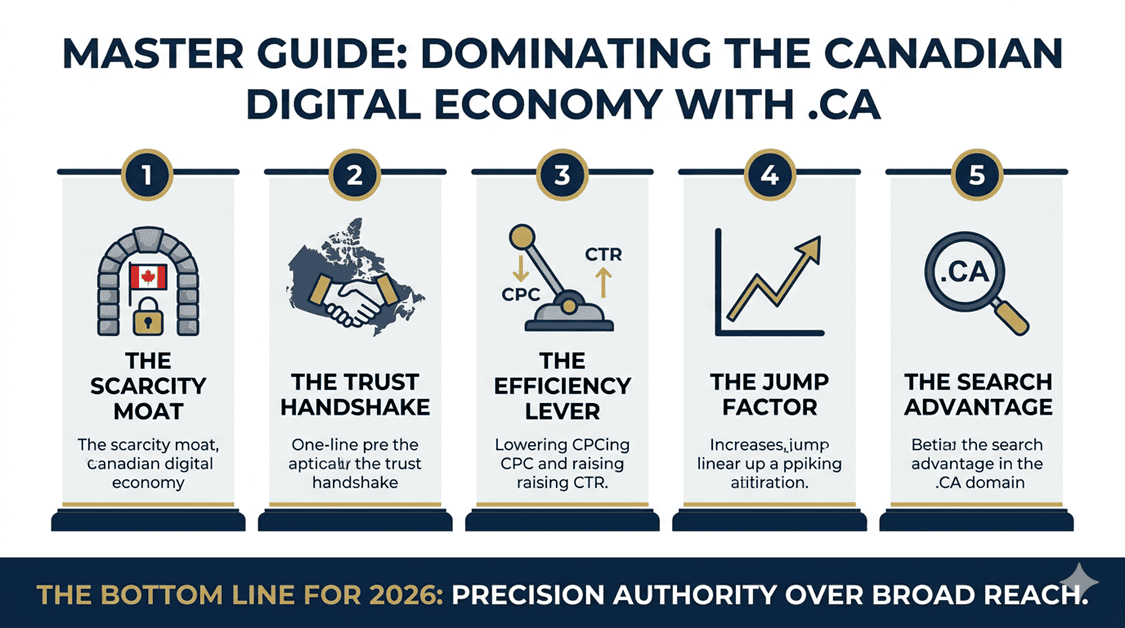
Unlike .com, which is a “land grab” with zero residency requirements, .CA has a strict Canadian Presence Requirement. This creates a natural “moat” around the extension:
When a domain extension is trusted, scarce, and tied to a stable economy, it becomes a high-yield digital asset. .CA checks every box, yet its secondary market pricing still lags behind comparable global markets.
For founders, investors, and marketers, this is the window.
Not hype. Just fundamentals.
If you’ve ever wondered why certain .CA names quietly sell for 5–6 figures, the next series of posts will unpack the specific mechanics of digital appraisal and acquisition.
Canadians don’t just buy differently; they trust differently.
In a global market, the .com is a “land grab.” In Canada, a premium .CA is a fortress of credibility.
Why the Psychology Shift Matters
For a Canadian consumer, seeing a .CA isn’t just about the URL. It’s a series of instant mental shortcuts:
The Asset Reality
This is why a savvy Canadian buyer will often pay a premium for the right .CA over a generic .com.
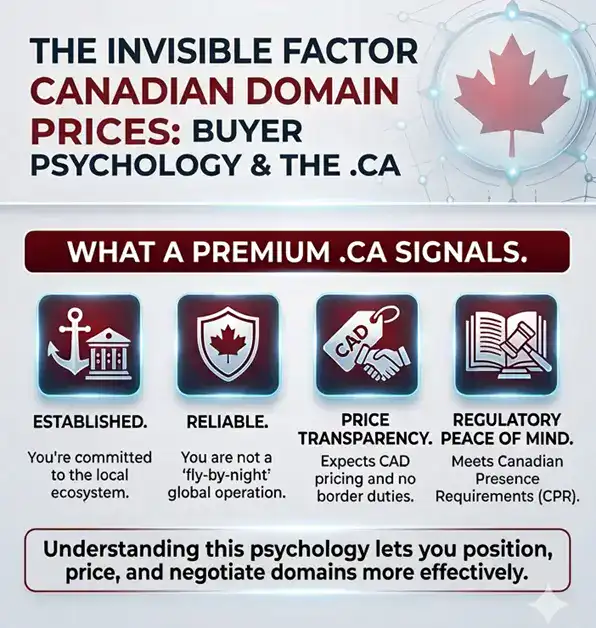
To them, the .CA isn’t just an address—it’s a signal that you are:
1️⃣ Established: You’ve committed to the local ecosystem.
2️⃣ Reliable: You aren’t a “fly-by-night” global operation.
3️⃣ Accessible: Your logistics and support are within their borders.
Whether you are pricing, negotiating, or positioning digital assets, if you treat Canada like “North USA,” you’re leaving value on the table.
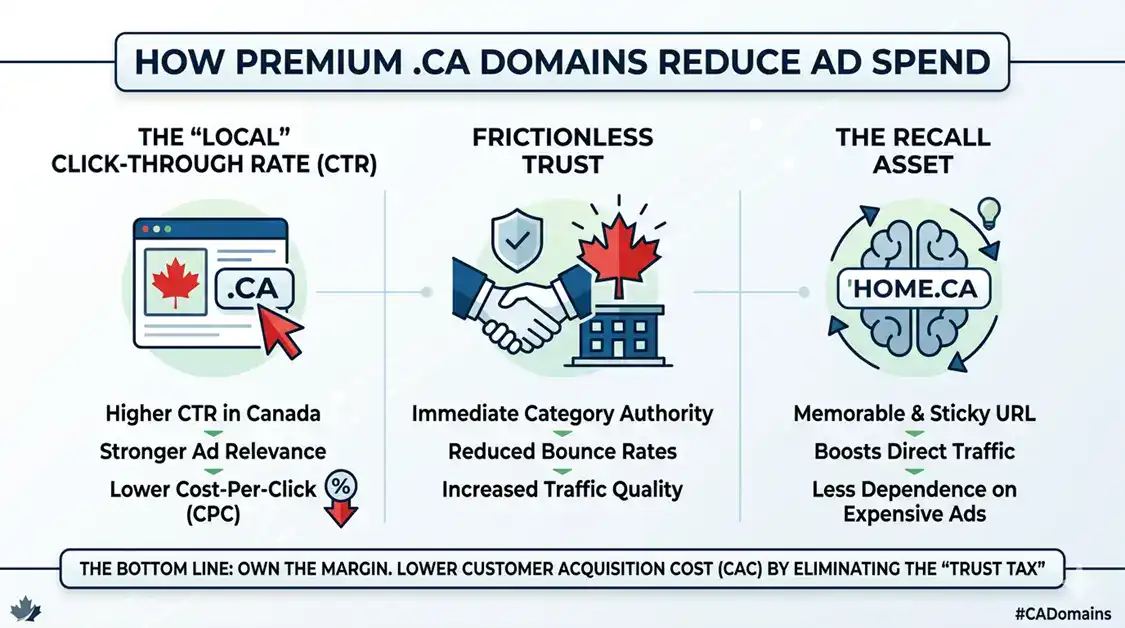
Most marketers treat their domain as a line item. Savvy Canadian investors treat it as an efficiency engine.
If you are running paid search or social ads in Canada, your domain isn’t just a destination—it is a primary driver of your Customer Acquisition Cost (CAC).
The .CA Efficiency “Moat”
In a global market of generic names, a premium .CA performs three invisible tasks that actively lower your marketing budget:
1️⃣ The “Local” Click-Through Rate (CTR):
Data consistently shows that Canadians are up to 3x more likely to click an ad with a .CA extension over a generic .com or .net. Higher CTR signals “relevance” to ad platforms (like Google and Meta), which rewards you with a lower Cost-Per-Click (CPC).
2️⃣ Frictionless Trust:
A premium .CA (like Loans.ca or Furniture.ca) carries immediate authority. When the domain is the category, you don’t have to spend your ad budget explaining who you are. This reduces “bounce” rates and increases the ROI on every dollar of traffic.
3️⃣ The Recall Asset:
A short, premium .CA is “sticky.” When a Canadian consumer sees your ad once, they remember the URL. This shifts future traffic from Paid to Direct, effectively cutting your long-term dependency on expensive ad platforms.
The Bottom Line for 2026:
Owning a category-leading .CA isn’t just a branding move—it’s about owning the margin.
By eliminating the “trust tax” associated with generic domains, you aren’t just buying an asset; you’re permanently subsidizing your own marketing costs.
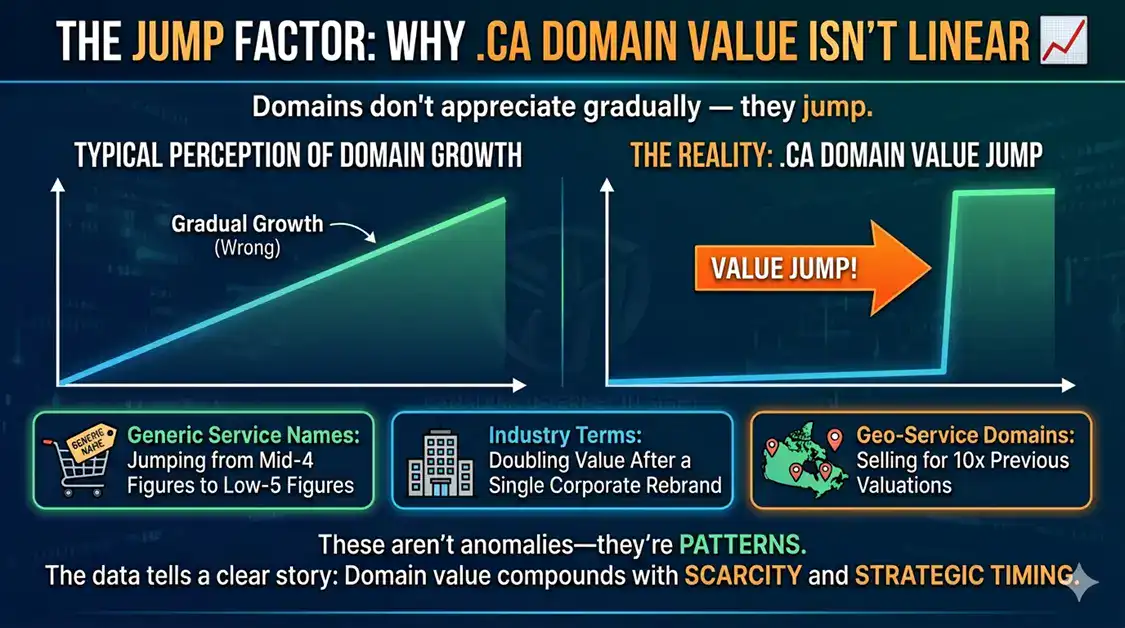
Most people assume digital assets appreciate like a slow-moving savings account. They don’t. They appreciate like venture-backed startups.
A premium .CA domain can sit quietly for years, then experience a 500% valuation “spike” in a single afternoon.
The Mechanics of a .CA Value Jump
These aren’t anomalies; they are the result of three specific market catalysts that we see repeatedly in the Canadian ecosystem:
1️⃣ The Corporate Rebrand Effect:
When a mid-sized Canadian firm decides to “own their category,” an industry-specific .CA (e.g., Logistics.ca) can jump from a mid-four-figure valuation to low-six figures overnight. The domain becomes the “strategic anchor” for their new identity.
2️⃣ The Geo-Service Surge:
We’ve seen geo-service domains (e.g., Toronto[Service].ca) sell for 10x their previous valuations as local competition reaches a fever pitch. In a crowded market, the domain is the only “shortcut” to page-one trust.
3️⃣ The Scarcity Catalyst:
Unlike .com, which is infinite, the .CA “Presence Requirement” creates a finite pool of owners. When a global player finally realizes they need a localized Canadian footprint, the price doesn’t just increase—it re-sets.
The Data Story
For founders and investors, the lesson is clear: Domain value doesn’t compound gradually. It compounds through scarcity and strategic timing.
If you’re waiting for “the right time” to acquire the category-defining name for your industry, remember that your competitor is likely looking at the same data.
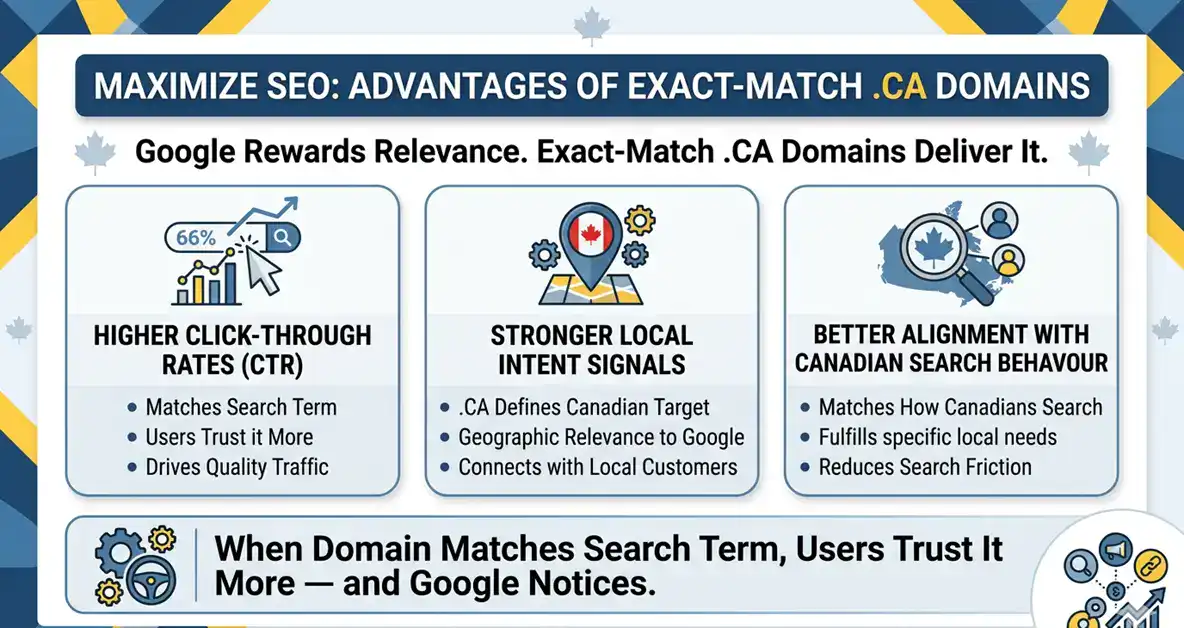
Google doesn’t guarantee rankings — but it has always rewarded relevance.
In the Canadian market, the Exact-Match Domain (EMD) on a .CA extension isn’t just an “old-school” tactic; it is a powerful signal of local intent that the current search algorithms prioritize.
The .CA SEO “Relevance Loop”
When your domain matches the search term (e.g., TorontoRealEstate.ca), it triggers three specific advantages that most marketers overlook:
1️⃣ The CTR Catalyst:
Users trust a domain that exactly matches their search query. A higher Click-Through Rate (CTR) is a primary signal to Google that your site is the “best” answer, which can lead to more stable, higher organic positions.
2️⃣ Local Intent Architecture:
The .CA extension is a hard-coded signal of Canadian relevance. When paired with a geographic or industry keyword, it tells the algorithm — and the user — exactly who you serve before a single page loads.
3️⃣ Search Behavior Alignment:
Canadians search with specific “local-first” patterns. An exact match .CA aligns perfectly with that intent, reducing the “friction” between a user’s question and your solution.
The Strategic Reality
If SEO is a core pillar of your growth, your domain should be the foundation of your strategy, not an afterthought.
Fighting for a generic global name often means spending more on backlinks and content just to prove the “local relevance” that a premium .CA gives you on Day 1.

In Canada, .CA is more than an extension — it’s a hard-coded trust signal.
While a .com is a global “land grab,” a premium .CA is a digital handshake. It’s an immediate, visual confirmation that your business is rooted in the local ecosystem, follows local regulations, and understands the Canadian consumer.
The “Home-Field” Advantage
In high-stakes industries, the choice of TLD (Top-Level Domain) is a primary driver of consumer psychology. We see this most clearly in:
When a Canadian sees a .CA, they aren’t just looking at a URL. They are subconsciously verifying:
1️⃣ Currency & Logistics: “I won’t be surprised by USD pricing or border duties.”
2️⃣ Legal Accountability: “This business meets the Canadian Presence Requirements (CPR).”
3️⃣ Cultural Alignment: “They understand my specific market needs.”
The Conversion Reality
This isn’t just about “feeling” local. That trust translates into measurable business outcomes:
If your brand serves Canadians, your domain should reflect that identity. Using a generic global extension for a local-first service is essentially fighting an uphill battle against your own audience’s instincts.
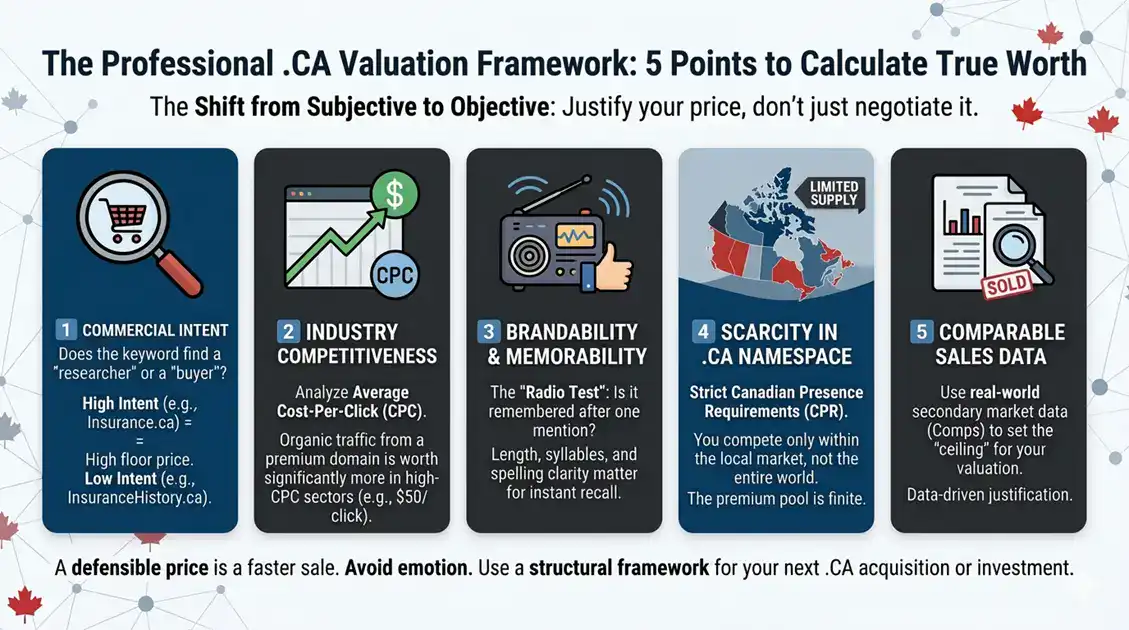
Most people price domains emotionally. Professionals price them structurally. 📈
In the Canadian market, a domain isn’t just an address — it’s a yield-bearing asset. But if you can’t defend the price, you don’t have an appraisal; you have a guess.
The Professional Valuation Framework
To find the “True Worth” of a .CA asset, you must look past the letters and evaluate the underlying fundamentals:
1️⃣ Commercial Intent: Does the keyword represent a “researcher” or a “buyer”? (e.g., Insurance.ca vs. InsuranceHistory.ca). High intent = High floor price.
2️⃣ Industry Competitiveness: Look at the Average CPC (Cost-Per-Click) in that sector. If competitors are paying $50/click, a domain that captures that traffic organically is worth significantly more.
3️⃣ Brandability & Memorability: Is it a “Radio Test” winner? If you say it once, does the customer remember it forever? Length and syllables matter.
4️⃣ Scarcity within the .CA Namespace: With strict Canadian Presence Requirements, the pool of premium .CA names is finite. Unlike .com, you aren’t competing with the whole world — only the local market.
5️⃣ Comparable Sales Data: Real-world data from the secondary market provides the “ceiling” for your valuation.
The Shift from Subjective to Objective
When you evaluate these factors objectively, pricing moves from “negotiation” to “justification.” A defensible price is a faster sale.
If you’re evaluating a digital asset for a rebrand, an acquisition, or an investment portfolio, don’t let emotion drive the decimal point. Use a structural framework to ensure you’re paying for value, not hype.
I’m happy to help the network:
If you want the simple 5-point framework I use for .CA valuations, comment “Valuation” below and I’ll send it over.
Premium .CA domains remain undervalued because the Canadian namespace is highly trusted, tightly regulated, and naturally scarce due to the Canadian Presence Requirements. Many global investors overlook this, creating a gap between market trust and market awareness.
The CPR restricts .CA ownership to qualified Canadian entities, preventing mass overseas registrations. This keeps supply limited, reduces speculative bulk buying, and ensures premium .CA domains remain exclusive, credible, and tied to real Canadian businesses.
Canadians associate .CA with local relevance, transparent pricing, and compliance with Canadian laws. A .CA instantly signals that a business operates in Canada, which increases trust, reduces friction, and improves conversion rates across all channels.
A strong .CA domain improves click‑through rates, lowers cost‑per‑click, and increases direct traffic. Canadians are more likely to click a .CA ad, and memorable category‑defining names reduce bounce rates and long‑term reliance on paid advertising.
Premium .CA domains often experience sudden valuation spikes when a business decides to rebrand, dominate a geo‑service area, or secure a scarce category‑defining keyword. These catalysts can push a domain from mid‑four figures to low‑six figures quickly.
Real .CA valuations are based on commercial intent, industry competitiveness, brandability, scarcity within the .CA namespace, and comparable sales data. Professional pricing relies on fundamentals—not emotion or guesswork.
Ready to turn your virtual real estate into a gold mine? List your domain names with Domain Buyers Market today and unlock the potential of your digital assets.
Complete the form for a no hassle chat on how our service can gain you more exposure and potential sales.
Let’s Chat – Free Consultation
We’ll help you launch your website. YOU can do this!
COOKIE POLICY:
This website uses cookies and other tracking technologies to enhance user experience and to analyze performance. No personal information is collected.